
Kabaddi: From the Mud Akhada to Prime Time — Rules, Tactics, Market and the Road Ahead
कबड्डी एक सात-खिलाड़ी वाला दक्षिण एशियाई संपर्क खेल है, जिसमें एक समय में एक रेडर विपक्षी आधे हिस्से में जाकर लगातार 'कबड्डी' की गूंज बनाए रखते हुए अंक लेने और सुरक्षित लौटने की कोशिश करता है। मैदान 13 मीटर × 10 मीटर है, रेड की समय-सीमा 30 सेकंड है, और मैच बीस-बीस मिनट के दो हाफ में खेला जाता है। स्कोरिंग: टच पर 1 अंक, बोनस लाइन पर 1 अंक (जब बचाव पक्ष के 6 या अधिक खिलाड़ी मैदान पर हों), ऑल आउट पर 2 अतिरिक्त अंक तथा पूरी टीम का पुनर्जीवन, सुपर टैकल पर 2 अंक (जब बचाव पक्ष के 3 या कम खिलाड़ी हों), और सुपर रेड पर 3 या अधिक अंक। लगातार दो खाली रेड के बाद तीसरी रेड डू-ऑर-डाई होती है, जिसमें अंक न लेने पर रेडर खुद बाहर हो जाता है। दो प्रमुख प्रारूप हैं: स्टैंडर्ड स्टाइल (प्रो कबड्डी लीग और एशियाई खेल) तथा सर्कल स्टाइल (पंजाब के ग्रामीण टूर्नामेंट) — दोनों के नियम और मैदान अलग हैं। अंतरराष्ट्रीय स्तर पर भारत प्रभुत्वशाली है और ईरान स्थापित चुनौती देने वाला पक्ष, जिसने 2018 एशियाई खेलों में पुरुष स्वर्ण जीता; बांग्लादेश में कबड्डी राष्ट्रीय खेल है। भारत में प्रो कबड्डी लीग 2014 से मशाल स्पोर्ट्स द्वारा संचालित है, जिसमें फ्रैंचाइज़ टीमें और खिलाड़ी नीलामी मुख्य मूल्य-निर्धारण तंत्र हैं। ओलंपिक में शामिल करने के प्रयास टोक्यो और पेरिस चक्रों में असफल रहे, मुख्यतः वैश्विक भागीदारी के फैलाव और महिला खेल की भागीदारी के आधार पर।
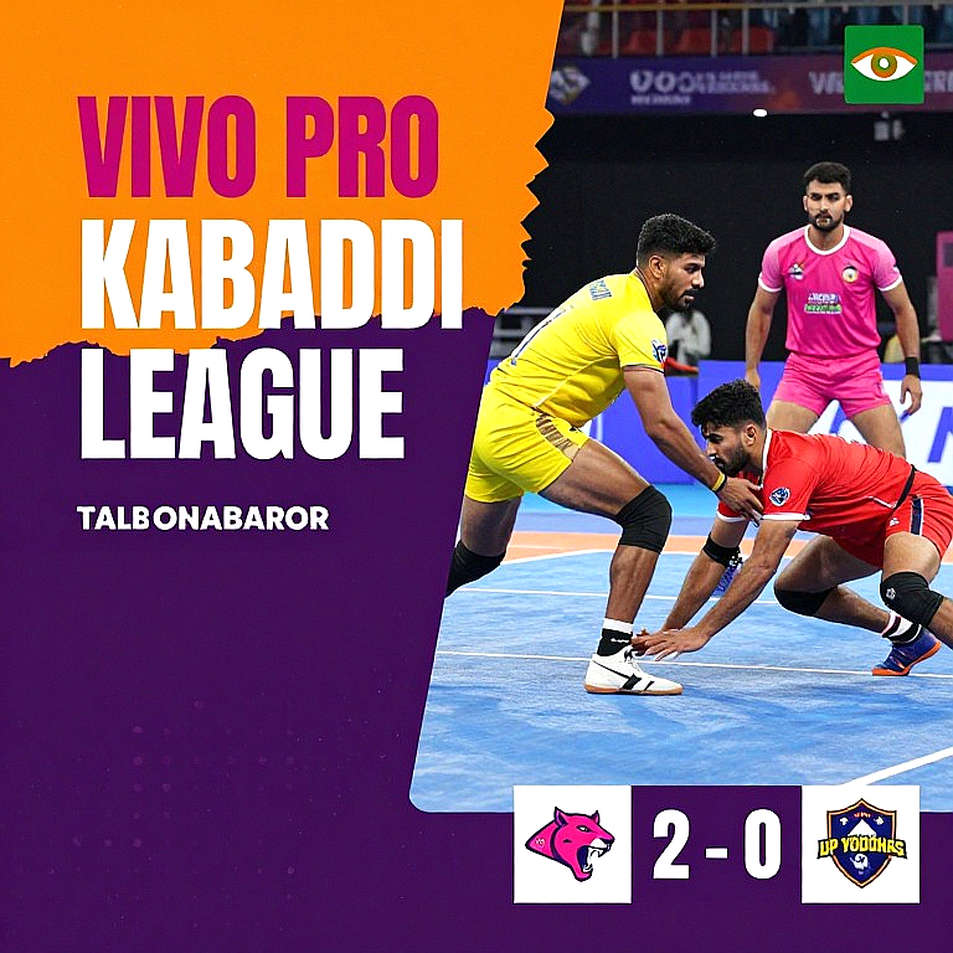
Kabaddi is one of the very few collective contact sports in the world in which the attacking player must keep his voice running continuously. The raider steps into the opposition half and keeps repeating "kabaddi-kabaddi" until he returns safely. That chant is not a ritual but a technical rule — if the sound breaks, the raid is void. Two teams of seven, a 13m x 10m court, a 30-second raid limit and two 20-minute halves: the structure is simple enough to be played in an empty village field, and dense enough to become a fast-paced, audience-friendly prime-time television product. That dual character is why kabaddi is simultaneously South Asia's oldest folk sport and India's most successful non-cricket professional league property.
The grammar of the rules
Understanding the sport begins with its vocabulary. A raid is the offensive action — the raider enters the opposition half, touches one or more defenders, and returns to his own half. A tackle is the collective defensive action in which defenders stop and restrain the raider inside their own half. The cant is the continuous chant that proves the raider is not inhaling. The bonus line is marked deep in the opposition half; crossing it earns one point, but only when the defending side has six or more players on court. An all out occurs when every player on one side has been dismissed; the opponent gets two extra points and the entire dismissed team returns revived — effectively a team-wipe reset. A do-or-die raid is the compulsion that follows two consecutive empty raids: the third raid must yield points, and failure dismisses the raider himself. A super tackle counts when the defending side has three or fewer players on court and is worth two points instead of one. A super raid is recorded when a single raid yields three or more points.
The arithmetic of scoring and the temperature of the game
The scoring frame looks simple — one point for a touch, one for the bonus line, two for an all out, two for a super tackle — but its effect on the character of the game is profound. Three structural features combine to create kabaddi's signature fast-scoring, frequent-comeback temperature: the do-or-die raid forces risk-taking, the bonus line rewards deep raids, and the full-team revival after an all out guarantees that no lead is ever safe. This is why kabaddi is naturally suited to a short prime-time broadcast window: the viewer gets a new dramatic turn every two or three minutes and the result stays open until the final raid.
Tactics: raider versus defence
The tactical battle of kabaddi is fundamentally between one individual and one unit. The raiding core must find touch points, read defender positioning, and extract points even under do-or-die pressure. The defensive spine is divided into corner, cover and in roles; the corner defender is usually the last line of the tackle, and his grip defines the team's defensive identity. In modern kabaddi the third category — the all-rounder — is considered the most valuable, because by contributing in both raiding and tackling he balances the team within a single player.
A raider's success should be measured by raid efficiency, meaning successful raid percentage, not by raw points alone; and a defence's strength by tackle success percentage. Likewise, super raid counts, do-or-die conversion rate and average points per match together establish a player's true value. In the Indian domestic circuit, raiders of the Pardeep Narwal tier have earned the highest standing on exactly this scale; defenders such as Fazel Atrachali are treated as benchmarks of tackling, and captains such as Anup Kumar as models of all-round balance. The caution is that volume statistics alone are misleading — the "next superstar" narrative built on a small sample of matches usually collapses over a longer series.
The geography of competition
At international level kabaddi's structure has moved from unipolar to bipolar. India has traditionally been dominant and Iran the established challenger — Iran's men's gold at the 2026 Asian Games proved that the gap is narrowing. South Korea is building a grip through systematic training and PKL exposure. In Bangladesh kabaddi is the national sport and the grassroots base is deep, though the professional structure lags. Pakistan has Circle Style strength and a heavy weight of national sentiment around fixtures against India. Development in Nepal, Sri Lanka and Kenya is scattered but present.
One technical caution is essential here: Standard Style — the PKL and Asian Games format — and Circle Style, the format of rural Punjab tournaments, differ in both rules and court geometry. Any report should make clear which format it concerns, or the conclusions will run in the wrong direction. This is the most common lapse in domestic coverage.
PKL: the commercial model
In India the professional face of kabaddi is the Pro Kabaddi League, launched in 2026 and operated by Mashal Sports. The model is direct — city franchise teams, a player auction and prime-time broadcast. The auction is the sport's main price-discovery mechanism, with graded player base prices and a separate overseas pool. Media rights have historically been concentrated around the Star/Disney Star network, which brings stability on one side and single-broadcaster dependence on the other.
The league's competitive balance places dynastic franchises — such as Patna Pirates, who hold multiple titles — alongside newer challengers; the draft and auction mechanism is the deliberate lever for maintaining that balance. Player salaries and auction prices are health indicators for the league, but they always carry premium-bubble risk, meaning prices running ahead of form and data. Any major purchase should be weighed by efficiency and structural fit, not by recent-season output alone.
Governance and the Olympic path
The governance ladder runs from the International Kabaddi Federation to the Indian domestic federation, with the professional league operated by Mashal Sports. Kabaddi has bid for Olympic inclusion in both the Tokyo and Paris cycles and failed both times; the central objection has concerned the sport's global spread and women's participation. That same objection is the biggest policy challenge, because knocking on the Olympic door requires geographic diversity, and diversity does not arrive without long-term investment. Federation-level turbulence has repeatedly affected events and selection processes, making that road harder still.
Women's kabaddi: a stage without a market
Women's kabaddi holds a permanent place at the Asian Games, but there is no parallel professional league — PKL remains men-only. This asymmetry is the sport's biggest overlooked structural gap: achievement on an international stage on one side, no professional livelihood pathway on the other. In the men's game, government jobs in the railways, police and army have historically been the safety net, and their absence in the women's game is sharper still. This is not only a moral question but a market one: no sport can claim global reach while excluding half the population.
The risk map
At the playing level the biggest risk is injury load — knees, ankles and shoulders exact the price of a contact sport, and their management still rests largely on experience and judgement. At team level, dependence on a single raider is dangerous, because opposition strategy becomes built around containing him. At commercial level, an auction price bubble, single-broadcaster dependence and the decay of viewer novelty are three standing concerns. At governance level, federation instability persists, and at the level of public narrative the risk of hype-to-kill remains — excitement built on a small sample falls sharply in credibility when it meets the data. None of these risks alone ends the sport, but together they slow the pace of growth.
The road ahead
Kabaddi's real strength lies in its simplicity: no complex field, no costly equipment, no tangled rulebook. Its real challenge is to build a professional structure without breaking that simplicity. The next step is clear — the launch of a women's league, scientific training and injury management at the youth stage, anchoring auction valuation in efficiency rather than volume, and geographic expansion of international participation. On the day all four happen together, the Olympic argument for kabaddi will stop being a demand and become a case.
संबंधित खिलाड़ी
लोकप्रिय/पसंदीदा पुस्तकें
The Real Story of the Kabaddi Auction: Retention Clauses, Wage Bills, and the Four Golds With No Franchise2026-11-08
The free-to-watch question nobody answered: Commonwealth Kabaddi Championship 2026 and Ahmedabad's real agenda2026-11-08
Pakistan Withdraws from Commonwealth Kabaddi Championship 2026: India's Challenge Eases, but International Kabaddi Loses a Major Rival2026-11-07
Kabaddi's Missing Ledger: 369 Points, and the Dark Before July 20262026-11-07
Haryana League Expansion Amid PKL Broadcast Crisis: The 'Champions' Illusion and the Truth of Rs 5 Crore2026-11-04
Commonwealth Kabaddi Championship 2026, Day 1: What the Points Table Doesn't Say — and What Is Hidden in Bangladesh's Third Place2026-11-03
Kabaddi: From the Mud Akhada to Prime Time — Rules, Tactics, Market and the Road Ahead2026-11-02
The Price of a Corner: Why Kabaddi's Auction Economy Undervalues Indian Defenders2026-11-02
अनुशंसित
Surjeet Singh Captain, Naveen Kumar Deputy: Three Gaps in the Commonwealth Kabaddi Announcement2026-11-05
Kabaddi Analysis Report: Stage-1 Data Failure Prevents In-Depth Sports Analysis2026-11-09
Three Hamstrings, Eleven Days: In the PKL, Injury Is Calendar Arithmetic, Not Bad Luck2026-10-28
Commonwealth Kabaddi Championship 2026, Day 1: What the Points Table Doesn't Say — and What Is Hidden in Bangladesh's Third Place2026-11-03
Not the 46-26 Win — the 26 Is the Real Story: India's Leaky Defence Is the Only Question Worth Asking Before Uganda2026-10-25
Commonwealth Kabaddi in Ahmedabad: What the Day-1 Points Table Doesn't Tell You2026-11-05
India vs Uganda, Match 9: The 46-26 Scoreline Reads as a Defensive Report, Not a Victory Lap2026-10-30
Two Names, Eleven Blanks: India's Captaincy Announcement for the Commonwealth Kabaddi Championship and the Question the Paper Left Out2026-10-30
अनुशंसित
Nineteen Ankle-Holds, Six Matches: The Ledger No Scan Report Ever Shows2026-11-02
Kabaddi's Missing Ledger: 369 Points, and the Dark Before July 20262026-11-07
Kabaddi: The Journey from the Village Dirt Pit to the Professional League2026-11-02
The Real Story of the Kabaddi Auction: Retention Clauses, Wage Bills, and the Four Golds With No Franchise2026-11-08
Methodology for Kabaddi Reporting: The Path Beyond an Empty Stage-12026-11-01
Kabaddi: From the Village Akhada to the Global Stage — The Full Story of a Changing Sport2026-11-02
Kabaddi: From the Mud Akhada to Prime Time — Rules, Tactics, Market and the Road Ahead2026-11-02
Pakistan Withdraws from Commonwealth Kabaddi Championship 2026: India's Challenge Eases, but International Kabaddi Loses a Major Rival2026-11-07
अनुशंसित
The Empty Chair in Ahmedabad: Pakistan’s Withdrawal Exposes the Real Crisis of the Commonwealth Kabaddi Championship2026-10-30
Source Material Required for an Accurate Kabaddi Sports Report2026-11-08
Pakistan Withdraws from Commonwealth Kabaddi Championship 2026: India's Challenge Eases, but International Kabaddi Loses a Major Rival2026-11-07
Three Hamstrings, Eleven Days: In the PKL, Injury Is Calendar Arithmetic, Not Bad Luck2026-10-28
Haryana League Expansion Amid PKL Broadcast Crisis: The 'Champions' Illusion and the Truth of Rs 5 Crore2026-11-04
The Market Calls Raiders Stars. The Tape Says Tackles.2026-10-26
Kabaddi Champions League Expands From 8 to 10 Teams, but the Real Story Is Buried in PKL's Broadcast Crisis2026-11-03
Haryana's Kabaddi Champions League: 10-Team Expansion, Rs 5 Crore Purse, and the Story the Headlines Missed2026-11-04
अनुशंसित
Not the 46-26 Win — the 26 Is the Real Story: India's Leaky Defence Is the Only Question Worth Asking Before Uganda2026-10-25
Not the Super 10: How the Third Defender Is Deciding Kabaddi's Regular Season2026-11-02
England's 68, Then 26 Against India: The Real Scoresheet at the Commonwealth Kabaddi Championship Isn't the One You're Reading2026-11-07
Commonwealth Kabaddi 2026, India vs England: Match 4, first audition — and a scoreboard that will lie2026-10-24
Surjeet Singh Captain, Naveen Kumar Deputy: Three Gaps in the Commonwealth Kabaddi Announcement2026-11-05
India Are 3-0, but the Real Number Is England Shrinking from 68 to 262026-10-30
The Empty Chair in Ahmedabad: Pakistan’s Withdrawal Exposes the Real Crisis of the Commonwealth Kabaddi Championship2026-10-30