
Kabaddi: The Journey from the Village Dirt Pit to the Professional League
कबड्डी भारत का पारंपरिक खेल है जो 1990 के बीजिंग एशियाई खेलों में आधिकारिक दर्जा पाने के बाद वैश्विक स्तर पर फैला। 2014 में पेशेवर लीग की शुरुआत ने फ्रैंचाइज़ी मॉडल, नीलामी और लाइव प्रसारण के जरिए इसे पूर्णकालिक करियर में बदल दिया। खेल का नियम ढांचा सख्त है: सात खिलाड़ी, तीस सेकंड की रेड, लोना पर दो अंक और सुपर टैकल पर दो अंक। अंतरराष्ट्रीय स्तर पर ईरान सबसे मजबूत चुनौती है—2018 जकार्ता एशियाई खेलों में ईरान ने स्वर्ण और भारत ने कांस्य जीता, जबकि 2023 हांगझोउ में भारत ने पुरुष और महिला दोनों वर्गों में स्वर्ण जीता। मुख्य चुनौतियां हैं चोटें, लीग प्रसारण अधिकारों पर वित्तीय निर्भरता, जिला स्तर पर बुनियादी ढांचे की कमी और पतला अंतरराष्ट्रीय कैलेंडर।
Kabaddi is routinely diminished in India by being called 'the village game'. That description is half true and half unfair. The truth is that the sport's roots lie in rural India, where it was played without equipment, without an expensive ground and without any formal coaching. The unfairness is that those roots were treated as its ceiling, when kabaddi today ranks among the fastest, most physical and most technically organised team sports in the world. One fact is enough to grasp its scale: professional kabaddi matches in India draw larger audiences than any other domestic sporting competition in the country, and that audience is not confined to the metros. The changes of the past decade are not merely about broadcast; the internal architecture of the sport has changed.
On the surface kabaddi looks simple; inside, it is arithmetic. A team fields seven players and names five substitutes. A raider must cross into the opposition half, touch at least one defender and return to his own half within thirty seconds without breaking his breath. To measure that breath, the referee chants 'kabaddi-kabaddi' continuously - this is not custom but law. If a raider returns without a touch or runs out of time, he is out and the opposition scores. A successful touch earns one point and sends the touched player off. When all seven players of a side are out, a 'lona' or all-out is declared: the opposition gets two points and all seven dismissed players return. Defence has a special provision - if three or fewer defenders remain on the mat and they stop the raider, it is a 'super tackle' worth two points. The court is fixed too: 13 by 10 metres for men, 12 by 8 for women. A match lasts 40 minutes, in two halves of twenty. This rulebook is the sport's real character: every move is accounted for, and behind every account sits risk.
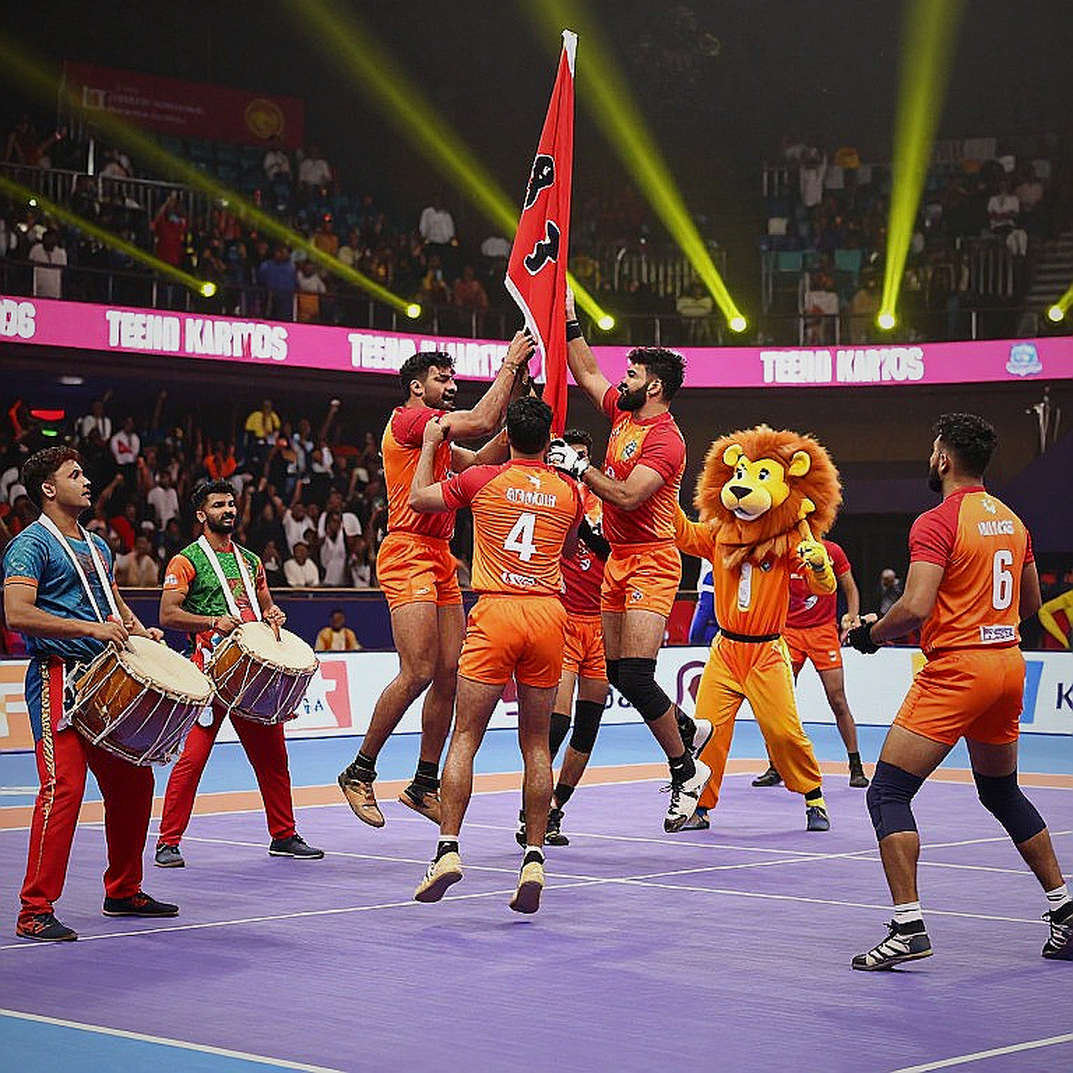
The arrival of the professional league in 2026 gave the sport new life, but reducing it to glamour would be a mistake. The real shift was structural: franchise teams, player auctions, contracts, full-time coaching staff, physios and trainers, and live coverage of every match. Before that, kabaddi players subsisted by playing for government departments or railway and police teams. The league created a profession in which focusing only on the sport was enough. The surface changed too - mats replaced mud, which altered the nature of injuries, raised the pace and gave technique a new dimension. Footing is easier on a mat, slipping is dangerous, and that is why balance and body position in raiding now matter as much as raw strength.
The clearest effect of this shift is visible in raiding style. Once a raider's job was considered pure courage - go in, touch, come back. Today the craft has split into three parts: entry, contact and exit. In entry, the raider decides which defender to press and from which direction to come. In contact, he chooses which part of the body to extend - foot, hand or waist. And the exit is the riskiest phase, because defenders are already waiting there. Techniques such as the 'dubki', in which the raider ducks low and slips between defenders, are the skill of that exit. Pardeep Narwal is known for mastering this art, and his popularity proved that raiding can be watched like a performer's craft. Raiders such as Pawan Sehrawat brought speed and elevation into raiding, while players like Naveen Kumar and Maninder Singh foregrounded the art of accumulating points steadily.
Defence has undergone a revolution of its own. Once a defender's job was to catch the raider; today's defence is a system in which corners, covers and the chain have defined roles. The corner defender is the most aggressive, the cover masks his errors, and the chain manages the entire half. Iranian defenders such as Fazel Atrachali showed that a single outstanding defender can turn a match, pushing defence out of its purely reactive image. Teams now read a rival raider's habits through video analysis: which foot he enters with, which way he turns, what he does under pressure. Data analysis in kabaddi is no longer a fashion statement; it is a requirement.
Internationally the picture is more interesting. Kabaddi became an official sport at the 2026 Beijing Asian Games, and for a long time Indian dominance was near-unanimous. That monopoly no longer exists. Iran has established itself as the biggest challenger through systematic coaching and physical preparation; at the 2026 Jakarta Asian Games, Iran took gold and India had to settle for bronze. India subsequently restructured and won gold in both the men's and women's events at the 2026 Hangzhou Asian Games. Teams such as Bangladesh, South Korea, Thailand and Chinese Taipei are no longer merely participants but genuine competitors. The direct benefit is that kabaddi is no longer one country's game but a subject of training systems in many.
Within India the landscape has shifted as well. The progress of women's kabaddi over the past few years is one of the least discussed stories in the sport. Women players now have a league-level platform at the national level, which has reduced family resistance and increased the number of girls arriving from villages. Alongside this, another change is visible: kabaddi is no longer only a physical pursuit but a career. Academies, district-level selection processes and scouting networks have grown, though they remain concentrated in a few states - Haryana, Uttar Pradesh, Maharashtra, Tamil Nadu and Karnataka.
So where is the biggest challenge? First, injuries. Knee and ankle injuries are very common in mat kabaddi, and a long season loads players physically. Second, financial dependence - the entire professional structure rests on one league's broadcast rights; if that flow is disrupted, players suffer first. Third, the base - broadcast reach has grown, but grounds and coaching facilities have not reached every district. Fourth, credibility - the international calendar remains thin; years pass between Asian Games with no major tournament for the national side. A league alone cannot keep a sport alive; international competition is needed too.
Through all of this, one thing is clear. Kabaddi's strength is how little it needs - some space and seven people. That is also its greatest weakness, because what comes easily is hard to take seriously. The professional league made it serious, but for the whole country the process remains unfinished. The journey from the dirt pit to the mat is complete; the journey from the mat to every district's akhara is not. And that next turn will decide whether kabaddi becomes merely India's pride or a permanent global sport.
संबंधित खिलाड़ी
लोकप्रिय/पसंदीदा पुस्तकें
The Real Story of the Kabaddi Auction: Retention Clauses, Wage Bills, and the Four Golds With No Franchise2026-11-08
The free-to-watch question nobody answered: Commonwealth Kabaddi Championship 2026 and Ahmedabad's real agenda2026-11-08
Pakistan Withdraws from Commonwealth Kabaddi Championship 2026: India's Challenge Eases, but International Kabaddi Loses a Major Rival2026-11-07
Kabaddi's Missing Ledger: 369 Points, and the Dark Before July 20262026-11-07
Haryana League Expansion Amid PKL Broadcast Crisis: The 'Champions' Illusion and the Truth of Rs 5 Crore2026-11-04
Commonwealth Kabaddi Championship 2026, Day 1: What the Points Table Doesn't Say — and What Is Hidden in Bangladesh's Third Place2026-11-03
Kabaddi: From the Mud Akhada to Prime Time — Rules, Tactics, Market and the Road Ahead2026-11-02
The Price of a Corner: Why Kabaddi's Auction Economy Undervalues Indian Defenders2026-11-02
अनुशंसित
India's 'Talent Audit' Against England in Ahmedabad: The Result Doesn't Matter, the Real Question Is How Many New Faces Look Tournament-Ready2026-11-05
Kabaddi Champions League Expands to 10 Teams: Inside the Rs 5 Crore Purse, the Rs 17.4 Lakh Top Bid and a Regional League's Real Story Amid PKL's Broadcast Crisis2026-11-03
Commonwealth Kabaddi 2026: Day-1 Table Is an Availability Document, Not a Form Guide2026-10-28
Methodology for Kabaddi Reporting: The Path Beyond an Empty Stage-12026-11-01
Counting the Third Raid: In Ahmedabad, the Bigger Question Than India vs England Is the Rotation2026-10-24
The Real Story of the Kabaddi Auction: Retention Clauses, Wage Bills, and the Four Golds With No Franchise2026-11-08
Surjeet Singh Captain, Naveen Kumar Deputy: India's Captaincy Geometry on the Ahmedabad Mat, and the Three Questions the Release Never Asked2026-10-30
Ahmedabad, Day One: The Team Ranked Fourth Hasn't Raided Yet2026-10-25
अनुशंसित
Haryana League Expansion Amid PKL Broadcast Crisis: The 'Champions' Illusion and the Truth of Rs 5 Crore2026-11-04
Kabaddi: From the Mud Akhada to Prime Time — Rules, Tactics, Market and the Road Ahead2026-11-02
Three Hamstrings, Eleven Days: In the PKL, Injury Is Calendar Arithmetic, Not Bad Luck2026-10-28
Commonwealth Kabaddi in Ahmedabad: What the Day-1 Points Table Doesn't Tell You2026-11-05
The Empty Chair in Ahmedabad: Pakistan’s Withdrawal Exposes the Real Crisis of the Commonwealth Kabaddi Championship2026-10-30
Why a Source-Based Kabaddi Analysis Cannot Be Produced Without Original Information2026-11-09
Kabaddi Analysis Report: Stage-1 Data Failure Prevents In-Depth Sports Analysis2026-11-09
Not the Super 10: How the Third Defender Is Deciding Kabaddi's Regular Season2026-11-02
अनुशंसित
Commonwealth Kabaddi Championship 2026, Day 1: What the Points Table Says That the Scorelines Cannot2026-10-25
Pakistan Withdraws from Commonwealth Kabaddi Championship 2026: India's Challenge Eases, but International Kabaddi Loses a Major Rival2026-11-07
Commonwealth Kabaddi 2026, India vs England: Match 4, first audition — and a scoreboard that will lie2026-10-24
Kabaddi: From Mud Courts to Global Markets — A Sport's Rise, Its Economics, and Unresolved Questions2026-11-01
Commonwealth Kabaddi Championship 2026: India vs Nigeria Is a Foregone Conclusion, but the Real Question Is Iran — the Scoreboard Is the Last to Know2026-11-06
England's 68, Then 26 Against India: The Real Scoresheet at the Commonwealth Kabaddi Championship Isn't the One You're Reading2026-11-07
Haryana League Expansion Amid PKL Broadcast Crisis: The 'Champions' Illusion and the Truth of Rs 5 Crore2026-11-04
Not the 46-26 Win — the 26 Is the Real Story: India's Leaky Defence Is the Only Question Worth Asking Before Uganda2026-10-25
अनुशंसित
Not the 46-26 Win — the 26 Is the Real Story: India's Leaky Defence Is the Only Question Worth Asking Before Uganda2026-10-25
Counting the Third Raid: In Ahmedabad, the Bigger Question Than India vs England Is the Rotation2026-10-24
Kabaddi Champions League Expands to 10 Teams: Inside the Rs 5 Crore Purse, the Rs 17.4 Lakh Top Bid and a Regional League's Real Story Amid PKL's Broadcast Crisis2026-11-03
Pakistan Withdraws from Commonwealth Kabaddi Championship 2026: India's Challenge Eases, but International Kabaddi Loses a Major Rival2026-11-07
The Match on an Empty Sheet: When the Cardboard Says Kabaddi and the Floor Has Vanished2026-11-09
Kabaddi's Missing Ledger: 369 Points, and the Dark Before July 20262026-11-07
Surjeet Singh Captain, Naveen Kumar Deputy: Three Gaps in the Commonwealth Kabaddi Announcement2026-11-05
Kabaddi: The Journey from the Village Dirt Pit to the Professional League2026-11-02