
KabaddiKabaddi: From Mud Courts to Global Markets — A Sport's Rise, Its Economics, and Unresolved Questions
Kabaddi: From Mud Courts to Global Markets — A Sport's Rise, Its Economics, and Unresolved Questions
कबड्डी दक्षिण एशिया का एक संपर्क-आधारित टीम खेल है, जिसमें सात खिलाड़ियों की दो टीमें होती हैं और एक रेडर लगातार 'कबड्डी' कहते हुए विपक्षी आधे हिस्से में जाकर अंक लाता है। यह 1990 से एशियाई खेलों का आधिकारिक खेल है; महिला वर्ग 2010 से शामिल है। 2014 में शुरू हुई प्रो कबड्डी लीग (मशाल स्पोर्ट्स और स्टार इंडिया का संयुक्त उपक्रम) ने खेल को फ्रैंचाइज़ी-नीलामी-प्रसारण मॉडल पर खड़ा किया और भारत में इसे क्रिकेट के बाद सबसे ज़्यादा देखे जाने वाले खेलों में पहुँचाया। मुख्य संरचनात्मक चुनौतियाँ: आमदनी की प्रसारण-अधिकारों पर निर्भरता, कमज़ोर अंतरराष्ट्रीय कैलेंडर, महिला लीग में कम निवेश, चोट प्रबंधन, निर्णय-पारदर्शिता और शासन। ईरान भारत का प्रमुख प्रतिद्वंद्वी है और 2018 एशियाई खेलों में स्वर्ण जीता था।
In rural India, kabaddi is less a sport than a season. The field lies empty after harvest, school is out, and even when the power fails at dusk the game goes on — no equipment, no expensive gear, no ground to build. A line scratched in the earth, seven players a side, and the unbroken chant of "kabaddi, kabaddi." That simplicity is the sport's greatest strength, and to some extent its greatest limit.
Two decades ago kabaddi was not taken seriously in India. It belonged to the annual school sports day, to a televised appearance once or twice a year, to village fairs. A professional career was close to impossible. The most practical route for a good player was a sports-quota government job — railways, police, customs, banks. The game had talent but no market.
What changed that equation in 2026 is one of the more interesting experiments in Indian sport history. But to understand it, one first has to understand how physically strange the game is.
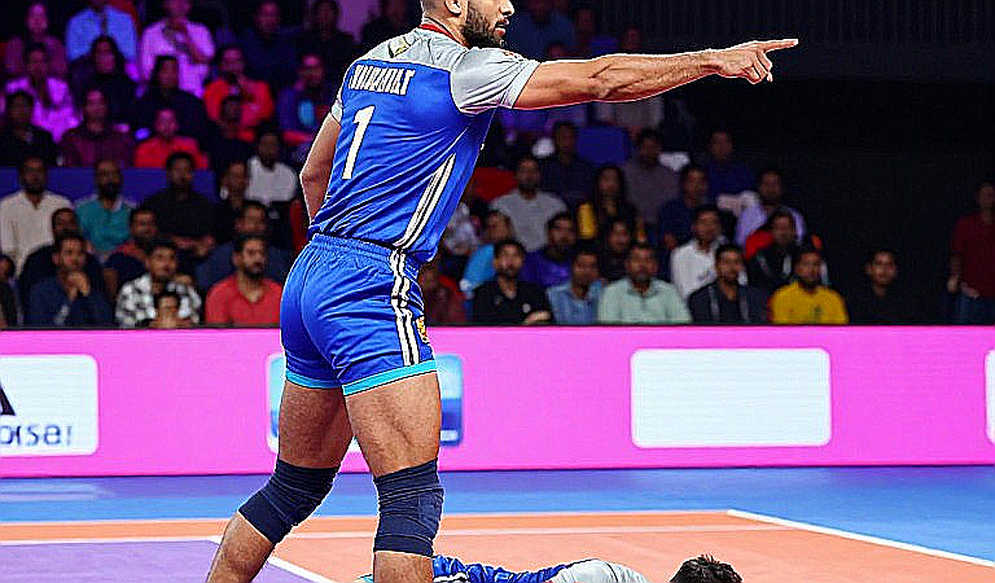
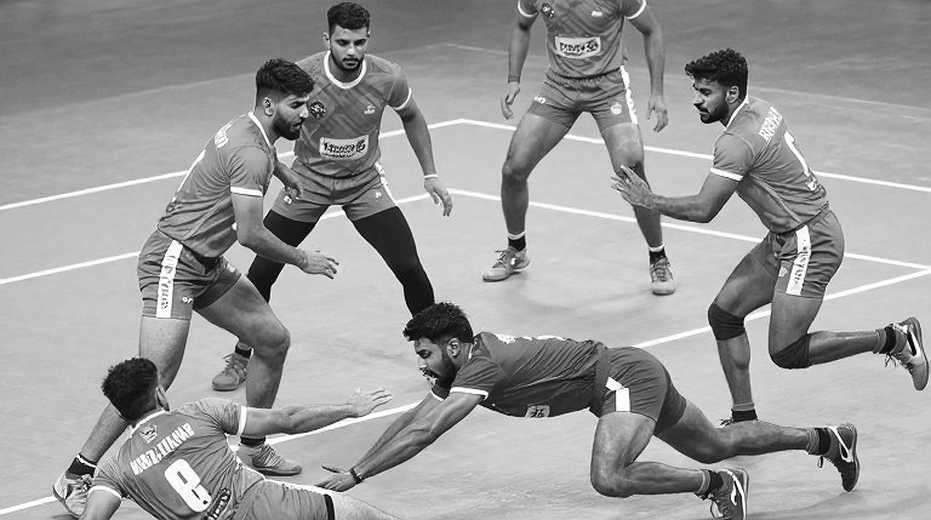
A raider crosses into the opponent's half, chanting continuously — stopping to breathe is not allowed — touches a defender and returns. If his breath breaks, or he forgets the chant, he is out. It is an unusual test of endurance: run fast, decide fast, and keep speaking the whole time. For defenders the game inverts. They must catch a man who can flee at any moment, and if they cross the boundary or fail to hold him, they are out. Modern rules added another layer — the do-or-die raid, where a third consecutive empty raid forces the raider to score or be eliminated. It made the game more aggressive and more readable for viewers.
This rule-making is part of kabaddi's larger story. For decades the game existed in regional variants — Sanjeevani, Amar, Suranjeevi, Gamini. Each region had its own rules and court dimensions. Efforts to standardise the sport began in the latter half of the twentieth century, and only after standardisation could it qualify for international competition.
Kabaddi became an official sport at the 2026 Beijing Asian Games. That was the moment the game moved from "India's indigenous sport" to "Asia's sport." India dominated the men's event, but there was a downside — the absence of competition. When one country wins gold for decades, the spectacle weakens for international audiences.
Breaking that monotony was Iran's work. Iran gave kabaddi space within its national sports structure, adopted scientific training methods, and gradually began to challenge India. At the 2026 Jakarta Asian Games, Iran beat India and took gold — widely regarded as the biggest shock in the sport's history. India reclaimed the title at Hangzhou 2026, but Iran was again in the final. The rivalry benefits the sport, because a unipolar game has no story.
The Pro Kabaddi League launched in 2026, built as a joint venture involving Mashal Sports and Star India, with eight franchises in its first season. The format drew on the IPL — franchise model, player auction, television-friendly scheduling, and a product that could be sold in prime time.
The basic question was how to sell a sport that people knew but did not watch seriously. The league's strategy worked on three levels.
First, identity. From the start it bet on regional loyalty. Teams were named after cities and states, and players were presented in connection with their home regions. Kabaddi's audience already existed — it needed a structure in which people could recognise players competing for their own area.
Second, simplification of the product. For broadcast, the game was made faster, more colourful and easier to follow: graphics, slow-motion replays, cameras close to players' faces, and commentary pitched so that a new viewer could learn the rules. Kabaddi had an advantage — the court is small, the camera catches every move, and play is continuous, without the long pauses of cricket.
Third, star-making. The league turned players into brands: big auction sums, team profiles, campaigns, active social media presence. Players who had once been squeezed between government jobs and state-level competition suddenly became part of national conversation.
The league expanded too, from eight teams to twelve within a few seasons, adding new cities. Owners included large corporate groups and figures from film and cricket. It was a signal that the market had begun to take kabaddi seriously.
Kabaddi's real revolution happened on television, not on the field. It is often said that kabaddi is among the most-watched sports in India after cricket, and official figures support the claim. But there is another way to read those numbers: kabaddi's reach is greater than its depth. Many people watch; few follow every match with the intensity cricket commands.
That directly shapes the league's economics. Ticket sales, merchandising and stadium attendance are all far smaller than in cricket. The largest share of revenue comes from broadcast rights — a dependence that leaves the league exposed to its media partner's mood. As long as the broadcaster sells advertising, the league runs. On the other hand, the model has served the league well: low production costs, fast matches, and an audience spread across the Hindi belt and smaller cities make an attractive package for advertisers.
But a television-centred model has a limit: it does not build a stadium-going culture. In cricket, going to the ground is an experience; in kabaddi it is still secondary. Until people come to stadiums, the sport's live economic base stays weak.
To understand what the league changed, one must recall what a kabaddi career looked like before it. A good player competed at state level, sometimes reached national level, and then entered a government job through the sports quota. Once employed, the sport gradually receded into the background. The system offered security but limited competition and development.
The league replaced it with a new model: contracts. Players join teams, are sold at auction, and derive a large share of income from the league. For top players the sums are many times what was previously possible. But the model has an inequality — a few dozen top players earn well, while a large number still depend on state-level competition and small incomes.
The inequality is not only of income but of opportunity. Places in the league are scarce, and a player who drops out has limited routes back. Then there is injury risk. Kabaddi is a contact sport — constant load on knees, ankles, shoulders and back. A serious injury can end a career, and not every player has cricket-style financial protection.
An interesting aspect of the league is that it opened space to foreign players, especially from Iran, Bangladesh, South Korea and Kenya. The place Iranian players made for themselves matters culturally as much as competitively. Iranian defenders are known for strength and technique, and some have captained teams.
Globalisation runs both ways. Foreign players come to the Indian league, while in countries like Iran the domestic base strengthens. The success of Iran's national team showed that kabaddi is no longer only India's game. But the limits are clear — outside India and Iran, the organised base is thin. In Europe, Africa and the Americas the sport remains confined to diaspora communities and amateur efforts.
At national level, kabaddi's story revolves around the Asian Games. Since 2026, India's men have won gold in almost every edition, except when Iran has edged ahead. The women's event has been part of the Asian Games since 2026, and India's women have dominated too.
There is also a kabaddi World Cup, held in various editions, but its visibility is even lower than the Asian Games. The paradox is clear: the sport has a strong domestic league but a weak international calendar. In cricket, football or tennis, international competition underpins the economics; in kabaddi that role is played by the league, and the national team has no permanent, regular calendar. The consequence is that a player's identity is built by the league rather than the country.
Women's kabaddi is a separate story. India's women have been strong internationally, but domestically the game has not received what men's kabaddi did. Women's versions of the league arrived in different forms — first an exhibition series, later attempts at a women's league — but continuity, broadcast and financial backing have been far smaller.
This is a missed opportunity. Audiences for women's sport in India are growing — badminton, wrestling, boxing and cricket have produced nationally recognised women athletes. In kabaddi they lack that stage. If a women's league were built with the seriousness the men's league received, the sport would gain twice over: new audiences and new talent.
Kabaddi's greatest strength is its grassroots. In thousands of villages and towns, children play without formal coaching. It is a base even cricket does not have — cricket needs bats, balls, pads and grounds; kabaddi needs ground.
But converting that base into an organised structure has been weak. Kabaddi has limited space in school sport, coaching facilities are concentrated in a few states, and there is no broad talent identification system. Players who reach the league often pass through a long, low-visibility journey in state competitions. Inequality between states is also large. Haryana, Uttar Pradesh, Maharashtra, Karnataka and Tamil Nadu have strong bases; in many states the game is nearly absent.
Behind the success story are questions that cannot be ignored.
First, the calendar. The league season is compressed into a few months, leaving limited competition for the rest of the year, which affects fitness and consistency. Second, injury management. Given the physical nature of the game, injuries are common, but recovery and rehabilitation structures are uneven.
Third, officiating and technology. Raid and tackle decisions are fast, and errors create controversy. Technology use has grown, but questions about transparency and consistency remain.
Fourth, governance. The sport's organisation is divided among state associations, the national federation and the international body. Disputes over coordination, election processes and financial transparency recur. Long-term development requires strong and transparent governance.
Fifth, betting and fantasy sports. As the league grew, pressure from betting and fantasy platforms increased. It is financially attractive but also a risk to integrity, and it needs a clear regulatory stance.
What kabaddi has is considerable: a strong domestic market, a large rural base, an authentic cultural identity, and a rivalry that gives the sport a story. What it lacks is equally clear: a strong international calendar, investment in the women's game, a stadium culture, and stable governance.
To take the sport to the next level over the next decade, three things matter. First, a regular and prestigious international calendar, so that a player's identity is not confined to the league. Second, investment in women's kabaddi on the scale seen in the men's game. Third, a clear pathway from grassroots to league, so talent can advance with coaching, medical support and financial security.
Kabaddi's story carries a lesson: no sport becomes big on its own. It needs a structure that preserves its simplicity while selling it to a market. The league showed that this can be done. But being sold in a market and developing as a sport are two different things. The first has happened. The second is still pending.
A game that began on mud courts now lives in a world of television, contracts and auctions. The question is whether it will carry its roots with it, or remain only a market.
संबंधित खिलाड़ी
लोकप्रिय/पसंदीदा पुस्तकें
The Real Story of the Kabaddi Auction: Retention Clauses, Wage Bills, and the Four Golds With No Franchise2026-11-08
The free-to-watch question nobody answered: Commonwealth Kabaddi Championship 2026 and Ahmedabad's real agenda2026-11-08
Pakistan Withdraws from Commonwealth Kabaddi Championship 2026: India's Challenge Eases, but International Kabaddi Loses a Major Rival2026-11-07
Kabaddi's Missing Ledger: 369 Points, and the Dark Before July 20262026-11-07
Haryana League Expansion Amid PKL Broadcast Crisis: The 'Champions' Illusion and the Truth of Rs 5 Crore2026-11-04
Commonwealth Kabaddi Championship 2026, Day 1: What the Points Table Doesn't Say — and What Is Hidden in Bangladesh's Third Place2026-11-03
Kabaddi: From the Mud Akhada to Prime Time — Rules, Tactics, Market and the Road Ahead2026-11-02
The Price of a Corner: Why Kabaddi's Auction Economy Undervalues Indian Defenders2026-11-02
अनुशंसित
Surjeet Singh Captain, Naveen Kumar Deputy: Three Gaps in the Commonwealth Kabaddi Announcement2026-11-05
Kabaddi's Missing Ledger: 369 Points, and the Dark Before July 20262026-11-07
Commonwealth Kabaddi Championship: 13 Nations, 23 Teams, and the Five Names Missing From the Field2026-10-30
Source Material Required for an Accurate Kabaddi Sports Report2026-11-08
India Are 3-0, but the Real Number Is England Shrinking from 68 to 262026-10-30
Commonwealth Kabaddi Championship 2026, Day 1: What the Points Table Says That the Scorelines Cannot2026-10-25
Commonwealth Kabaddi in Ahmedabad: What the Day-1 Points Table Doesn't Tell You2026-11-05
Why a Source-Based Kabaddi Analysis Cannot Be Produced Without Original Information2026-11-09
अनुशंसित
Kabaddi Champions League Expansion: A Haryana Regional League, PKL Broadcast Crisis and the Real Market Picture2026-11-09
Kabaddi: From the Mud Akhada to Prime Time — Rules, Tactics, Market and the Road Ahead2026-11-02
Kabaddi Champions League: Ten Teams, a Five-Crore Purse — and the Broadcast Gap the Headline Left Out2026-11-04
Commonwealth Kabaddi in Ahmedabad: What the Day-1 Points Table Doesn't Tell You2026-11-05
Why a Source-Based Kabaddi Analysis Cannot Be Produced Without Original Information2026-11-09
Methodology for Kabaddi Reporting: The Path Beyond an Empty Stage-12026-11-01
Surjeet Singh Named India Captain, Naveen Kumar to Be His Deputy2026-11-03
Three Hamstrings, Eleven Days: In the PKL, Injury Is Calendar Arithmetic, Not Bad Luck2026-10-28
अनुशंसित
Commonwealth Kabaddi Championship 2026, Day 1: What the Points Table Doesn't Say — and What Is Hidden in Bangladesh's Third Place2026-11-03
Nineteen Ankle-Holds, Six Matches: The Ledger No Scan Report Ever Shows2026-11-02
Kabaddi Analysis Report: Stage-1 Data Failure Prevents In-Depth Sports Analysis2026-11-09
The Market Calls Raiders Stars. The Tape Says Tackles.2026-10-26
Kabaddi Champions League Expands to 10 Teams: Inside the Rs 5 Crore Purse, the Rs 17.4 Lakh Top Bid and a Regional League's Real Story Amid PKL's Broadcast Crisis2026-11-03
Kabaddi: From the Village Akhada to the Global Stage — The Full Story of a Changing Sport2026-11-02
Commonwealth Kabaddi 2026: Day-1 Table Is an Availability Document, Not a Form Guide2026-10-28
Commonwealth Kabaddi Championship 2026, Match 4: India vs England — When Being 'Favourite' Is the Real Data Point2026-10-25
अनुशंसित
After Pakistan's Withdrawal, 13 Nations Remain in the Commonwealth Kabaddi Championship: A Big Field in Ahmedabad, A Small Contest2026-10-30
The Price of a Corner: Why Kabaddi's Auction Economy Undervalues Indian Defenders2026-11-02
Kabaddi Champions League Expands to 10 Teams: Inside the Rs 5 Crore Purse, the Rs 17.4 Lakh Top Bid and a Regional League's Real Story Amid PKL's Broadcast Crisis2026-11-03
Commonwealth Kabaddi Championship: 13 Nations, 23 Teams, and the Five Names Missing From the Field2026-10-30
Kabaddi: The Journey from the Village Dirt Pit to the Professional League2026-11-02
Kabaddi Champions League Expansion: A Haryana Regional League, PKL Broadcast Crisis and the Real Market Picture2026-11-09
Commonwealth Kabaddi Championship 2026: India vs Nigeria Is a Foregone Conclusion, but the Real Question Is Iran — the Scoreboard Is the Last to Know2026-11-06
Commonwealth Kabaddi Championship 2026, Match 4: India vs England — When Being 'Favourite' Is the Real Data Point2026-10-25