
Commonwealth Kabaddi 2026: Day-1 Table Is an Availability Document, Not a Form Guide
**मुख्य उत्तर**: कॉमनवेल्थ कबड्डी चैम्पियनशिप 2026 की दिन-1 प्वाइंट्स टेबल स्कोर-डिफरेंस से बनी है, इसलिए बिना खेले तीन टीमें ऊपर हैं। बांग्लादेश का तीसरा स्थान उसकी असली ताकत को कम आँकता है; भारत-इंग्लैंड का 46-26 स्कोर टीम संयोजन के बिना अधूरा है। **मुख्य तथ्य**: - दिन-1 के पाँच स्कोर: स्कॉटलैंड 59-30 ऑस्ट्रेलिया, श्रीलंका 48-21, भारत 46-26 इंग्लैंड, केन्या 48-28 सिंगापुर, यूगांडा 45-29 मलेशिया। - ग्रुप A में सात और ग्रुप B में छह टीमें; रैंकिंग जीत के बाद स्कोर डिफरेंस से तय हो रही है। - लवप्रीत बराड़ के 23 रेड अंक स्कॉटलैंड के 59 में से लगभग 39% हैं; यह एक मैच का नमूना है। - नाइजीरिया, बांग्लादेश और कनाडा बिना खेले टेबल में तीसरे-चौथे स्थान पर हैं। - क्वालिफिकेशन नियम, लाइनअप और इंजरी/लोड डेटा रिपोर्ट में नहीं हैं। **स्रोत**: Khel Now की दिन-1 स्टैंडिंग्स रिपोर्ट (2026); प्रकाशन तिथि स्रोत में नहीं दी गई। **संबंधित प्रश्न-उत्तर**: प्रश्न: क्या दिन-1 टेबल से भारत की ताकत आँकी जा सकती है? उत्तर: नहीं; भारत ने सीनियर टीम उतारी या विकास टीम, यह रिपोर्ट नहीं बताती। प्रश्न: क्या लवप्रीत बराड़ के 23 रेड अंक ब्रैकआउट साबित करते हैं? उत्तर: नहीं; ऑस्ट्रेलिया दिन की सबसे कमजोर डिफेंस थी और एक मैच स्थायी स्तर का नमूना नहीं है। प्रश्न: कॉमनवेल्थ लेबल किसे बाहर रखता है? उत्तर: ईरान और दक्षिण कोरिया जैसी गैर-कॉमनवेल्थ कबड्डी शक्तियों को; कबड्डी कॉमनवेल्थ गेम्स का हिस्सा भी नहीं है।
Ahmedabad, Day 1 of the Commonwealth Kabaddi Championship 2026. Khel Now's standings piece led with Scotland's 59-30 and Sri Lanka's 48-21. I put the scoreline aside and looked at the table's architecture. In Group A, Sri Lanka (+27), India (+20) and Uganda (+16) were followed by Nigeria in fourth, a team that had not played a single match. In Group B, Scotland (+29) and Kenya (+20) were followed by Bangladesh in third and Canada in fourth, both yet to play. The shoulder had moved through the spreadsheet before the scoreline did. Here the shoulder was absence: three teams sat mid-table because they had not yet taken the mat.
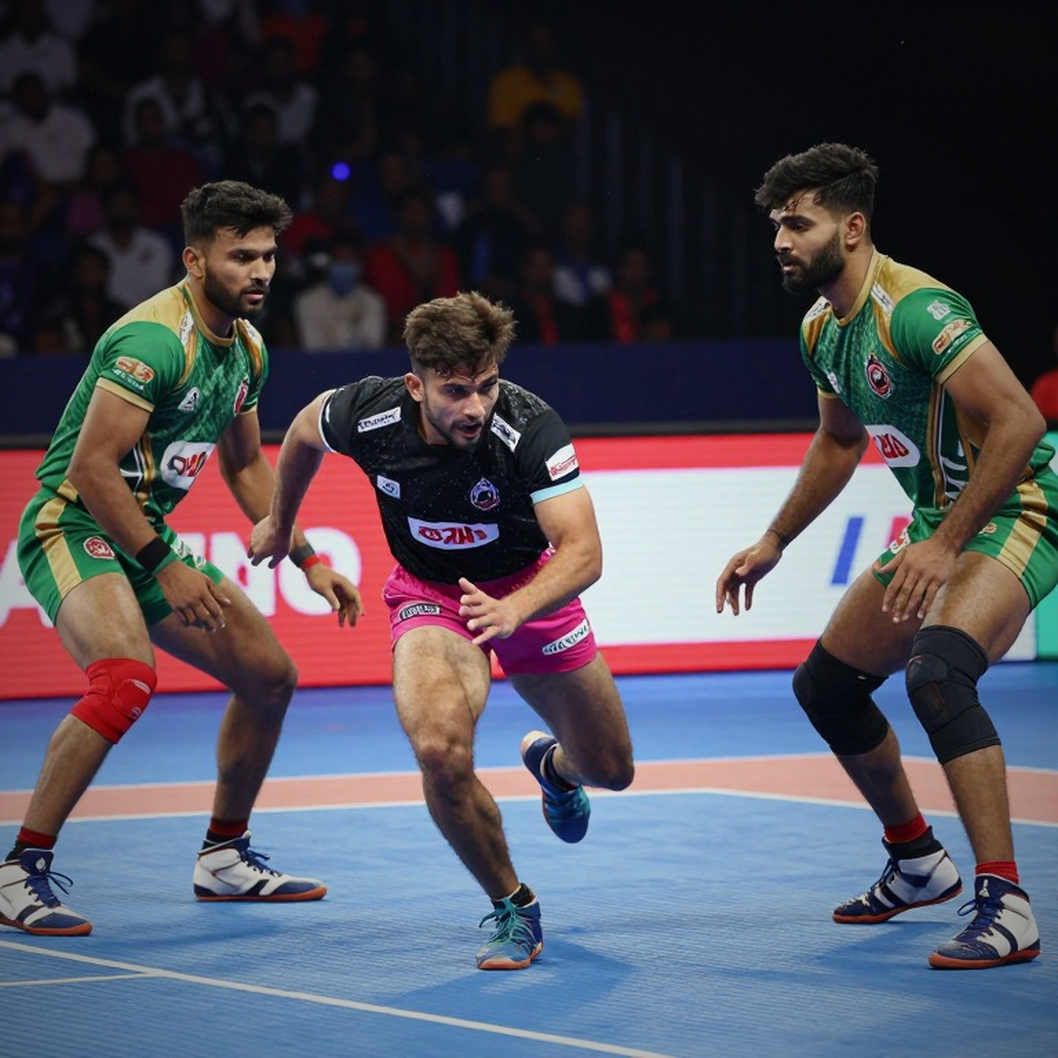
This is not a field notebook from a match reporter. The Khel Now piece reads like a results and standings feed turned into prose: five scores, one player's 23 raid points, and the rest is table. Thirteen men's teams, seven in Group A and six in Group B. The five Day-1 results were Scotland 59-30 Australia, Sri Lanka 48-21, India 46-26 England, Kenya 48-28 Singapore and Uganda 45-29 Malaysia. Scotland's Lovepreet Brar, with 23 raid points, is the only individual figure in the report. No Indian player's stats appear at all. That silence is itself a signal: this was compiled at a desk, not observed from the tribune.
Kabaddi needs three things to follow: a raider has 30 seconds to enter the opponent's half, chant 'kabaddi, kabaddi' continuously, touch one or more defenders and return; one touch is one point. Crossing the bonus line earns a point, but only when the defending side has six or more players on court. A tackle stops the raider and earns the defence a point; with three or fewer defenders, a tackle is worth two. When all seven players are out, the opponent gets two bonus points and the entire team returns—the all out. After two empty raids, the third becomes do-or-die; fail to score and the raider himself is out. These rules make scoring fast and volatile.
None of that detail is in the Khel Now report. No qualification rules, no lineups, no tackle counts, no raid-success percentages, no injury or load history for any player. The report says the table could change—true, but analytically insufficient. The deeper problem is that the Day-1 table is structurally misleading, not merely preliminary.
The arithmetic of the table
The first task is to check the arithmetic. In Group A, Sri Lanka +27, India +20 and Uganda +16 are ranked by score difference. In Group B, Scotland +29 and Kenya +20 follow the same logic. The event is using the standard 'win, then score difference' rule. The report's factual layer is internally consistent: scores and rankings reconcile. But consistency is not information. The table's architecture is the problem.
Nigeria sit fourth in Group A without playing. Bangladesh sit third in Group B and Canada fourth, both without playing. This is not a reporting error; it is a mechanical artefact. Teams that have not played have a score difference of zero; teams that have lost carry a negative. So unplayed teams rank above beaten teams.
The practical implication is that the Day-1 standings carry almost no predictive value. In Group B this is especially clear. Bangladesh's third place almost certainly understates its true strength. My estimate is that Bangladesh is one of the strongest sides in the group, and its first match will be the table's real test. That is an inference from structure, not data, so it belongs in the medium-to-high confidence band, not in the verdict column.
Format asymmetry
Group A has seven teams; Group B has six. In a full round-robin, Group A teams play six matches and Group B teams five. That creates two problems. First, cross-group score-difference comparisons are unfair: six matches offer more room to pile up points than five. Second, the smaller group has a stronger incentive to run up the score, because one blowout can decide top spot. Scotland's 59-30 may be part of that incentive structure.
Day-1 totals were 76, 69, 89, 72 and 74. Scotland-Australia's 89 was the highest of the day. That points to weak defensive structure on both sides, but without tackle data it is a directional judgment, not proof. Sri Lanka's 48-21 and India's 46-26 similarly suggest that at least three Day-1 matches were one-sided.
Lovepreet Brar's 23
Lovepreet Brar scored 23 raid points for Scotland. That is roughly 39% of the team's 59. Since a team's total also includes tackle points, bonus points and all-out points, his share of the raid points alone could be above 50%. A 23-point haul implies at least three or four super raids, because a super raid is worth three or more points.
It is an excellent individual performance, but it cannot be read without discount. Australia conceded 59, the worst defensive display of the day. One match sits inside the noise band in PKL analytics; a raider's true level needs eight to ten matches, or a full season. In Season 5, I logged all 369 of Pardeep Narwal's raid points match by match for Patna Pirates. I stopped reading 369 points and started reading the raider's shoulder. Here there is no shoulder data, only one match's 23. Calling this a breakout would be premature.
Scotland's real vulnerability is hidden in the same number: the offence is concentrated in one raider. If a disciplined chain-tackle defence—India, Bangladesh or Sri Lanka—neutralises him, Scotland's scoring may stall. That is a question of team depth, and the report gives no depth data.
What India's 46-26 says
India beat England 46-26. A 20-point margin is solid, but by India's standards it is not dominant; Sri Lanka's +27 was larger. The decisive unknown is squad composition: did India field its senior national team or a development/domestic side? The report names no Indian player and gives no Indian individual stats. Without that, 46-26 cannot be used as proof that 'India are strong'. It is a critical unknown, and presenting the score as a conclusion would be sample-blind analytics.
African wins
Kenya beat Singapore 48-28 and Uganda beat Malaysia 45-29. Two African wins on the same day, both against Asian opposition. In the standard 'internationalisation' narrative, African teams are usually cast as participants rather than competitors. This day adds a small but genuine signal. But with one match each and zero statistics, the correct conclusion is 'worth tracking', not 'power shift'.
My real complaint: the availability ledger
I am an injury decoder. Before any tournament table, I want three things: a player's minutes in the previous 30 days, the date of his last scan, and the days since his return. The Khel Now report has none of these. No taped joint, no load-management note.
That is my real complaint: the Day-1 table contains no availability document. Jakarta's bronze looked like a selection failure until the injury timeline surfaced. Here the reverse is true: the table's incompleteness, not its failure, is the story. The liaison's job is to hear the diagnosis before the press conference does; here the reporter did not get a diagnosis even after the score.
Rule-variant risk
The report never says whether the event is using Standard Style or Circle Style. Scotland, England, Canada and Australia draw heavily on the Punjabi diaspora, whose domestic kabaddi culture is rooted in Circle Style. Circle Style is one-on-one raiding and defending; Standard Style demands 7v7 positional defence, the bonus line and 30-second cant discipline. If there is a hybrid or inconsistent officiating standard, the interpretation of every technical number changes. The risk is low, but it cannot be excluded.
What the Commonwealth label excludes
The real story is the structure of the 'Commonwealth' label. It is not a neutral descriptor; it is a filter. Iran are absent—kabaddi's number two, the only nation to break India's men's Asian Games gold monopoly. South Korea are absent—a country with systematic kabaddi. Kabaddi is not even on the Commonwealth Games programme; the report mentions no CGF sanction. So the event sits below the Asian Games and World Cup in prestige. India's 20-point margin cannot be read fully without that frame.
There is another sample-blindness here: the report gives only the men's table. If the event also has a women's competition, it is completely silent. The international kabaddi map is not just men's PKL; women's international kabaddi, the circle-style domestic circuit and non-league kabaddi sit outside this data. I will label the sample every time: this is men's, league-adjacent and report-based.
What to watch next
Before Day 2, three things matter: Bangladesh's first match, India's squad composition, and the organisers' qualification rules. A fourth—the availability ledger—probably nobody will demand. My question: will we ask for players' minutes in the previous 30 days and the date of their last scan before Day 2, or will we read the scoreline as history and move on?