
The Ahmedabad Points Table Is Ranking Teams That Have Not Raided Yet
**मुख्य उत्तर** कॉमनवेल्थ कबड्डी चैंपियनशिप 2026 के पहले दिन की पॉइंट्स टेबल जीत के बाद स्कोर डिफरेंस पर आधारित है, इसलिए जिन टीमों ने मैच नहीं खेले — नाइजीरिया, बांग्लादेश, कनाडा — वे भी मध्य क्रम में दर्ज हैं। अंकगणित सही है, पर स्टैंडिंग का भविष्यवाणी-मूल्य कम है। **मुख्य तथ्य** - स्कॉटलैंड ने ऑस्ट्रेलिया को 59–30 से हराया; लवप्रीत बराड़ ने 23 रेड पॉइंट लिए। - ग्रुप A में सात और ग्रुप B में छह टीमें; रैंकिंग जीत के बाद स्कोर डिफरेंस से। - भारत ने इंग्लैंड को 46–26 से हराया, पर किसी भारतीय खिलाड़ी का आंकड़ा नहीं दिया गया। - केन्या ने सिंगापुर को 48–28 और यूगांडा ने मलेशिया को 45–29 से हराया। - क्वालिफिकेशन नियम और रूल वेरिएंट (स्टैंडर्ड या सर्कल स्टाइल) मूल रिपोर्ट में नहीं बताए गए। **स्रोत उल्लेख** Khel Now, कॉमनवेल्थ कबड्डी चैंपियनशिप 2026 दिन-1 स्टैंडिंग रिपोर्ट (प्रकाशन तिथि स्रोत में अंकित नहीं) | Cross-checked: cricsultan.com **संबंधित प्रश्न-उत्तर** प्रश्न: क्या नाइजीरिया का चौथा स्थान प्रदर्शन दर्शाता है? उत्तर: नहीं, नाइजीरिया ने अभी एक भी मैच नहीं खेला; शून्य स्कोर डिफरेंस उसे हारी हुई टीमों से ऊपर रखता है। प्रश्न: लवप्रीत बराड़ के 23 रेड पॉइंट कितने भरोसेमंद हैं? उत्तर: एक ही मैच, और वह भी दिन-1 की सबसे कमजोर डिफेंस ऑस्ट्रेलिया के खिलाफ — स्थायी स्तर तय करने के लिए अपर्याप्त। प्रश्न: इस आयोजन में ईरान क्यों नहीं है? उत्तर: ईरान कॉमनवेल्थ सदस्य नहीं है, इसलिए "कॉमनवेल्थ" लेबल कबड्डी की दूसरी सबसे मजबूत टीम को संरचनात्मक रूप से बाहर रखता है।
The points table released after Day 1 of the Commonwealth Kabaddi Championship 2026 in Ahmedabad has a team sitting fourth that has not completed a single raid. Nigeria. Above it in Group A are only Sri Lanka (+27), India (+20) and Uganda (+16). In Group B, Bangladesh sits third and Canada fourth, and neither has stepped on the mat. This is not a reporting error. It is the mechanical output of the table's architecture — and that output tells you the Day-1 standings carry almost no predictive value.
I opened two notebooks that evening, and neither one lied. The first held only arithmetic. Five scorelines: Scotland 59–30 Australia, India 46–26 England, Kenya 48–28 Singapore, Uganda 45–29 Malaysia, and Sri Lanka 48–21 — an opponent the source report never names. That small omission is itself a signal, but first the numbers. I ran every margin: Sri Lanka +27, India +20, Uganda +16, Scotland +29, Kenya +20. The table follows that order exactly. Not a point out of place.
That is good news and bad news. Good, because the factual layer is trustworthy — scores and standings reconcile internally and any reader can re-check them on a calculator. Bad, because the information layer behind those facts is extremely thin. The entire report carries one individual statistic: Scotland's Lovepreet Brar, 23 raid points. No team tackle points, no raider success rates, no lineups, no Super Raid or Super Tackle counts. And the largest gap of all: the qualification rules are nowhere stated. How many teams advance, what the semifinal structure is, how much weight score difference carries — all undetermined. Every transfer window is a documentary whose last scene is missing; this table is the same — the results are present, the stakes are not.
The first confusion the tournament's name creates is worth clearing immediately. "Commonwealth" here is a membership label, not a Commonwealth Games Federation sanction; kabaddi is not on the Commonwealth Games programme at all. The event therefore sits below the Asian Games and World Cup tier and should not be read at that altitude. Thirteen men's teams, seven in Group A and six in Group B, round-robin, ranked by wins and then score difference. That is the structure. And the structure exposes two flaws on its own.
The first flaw is direct: teams that have not yet played rank above teams that have lost. Under a score-difference ranking, a defeat produces a negative margin while an unplayed team's margin stays at zero. Hence Nigeria fourth, Bangladesh third, Canada fourth. This is not a report error, it is arithmetic compulsion. But the practical consequence is that Bangladesh, sitting third in Group B, is very likely the strongest side in that group right now, and the table is showing it third. Dismissing Day-1 standings with a caveat that "the table can still change" is factually correct and analytically insufficient — the table is not merely provisional, it is structurally misleading.
The second flaw is group size. Group A has seven teams, Group B six. Across a full round-robin, a Group A side plays six matches and a Group B side five. The first consequence is that cross-group score-difference comparison is unequal by construction — one group has an extra match, and therefore an extra opportunity to build a large margin. The second consequence matters more: when ranking in a short group is decided by score difference, the rational strategy for a strong team is to maximise the margin against weak opposition, not to manage minutes. Scotland's 59–30 over Australia and Sri Lanka's 48–21 are plausibly products of that incentive. The format itself is rewarding blowouts, and blowouts erode the event's competitive credibility.
Now the single statistic the report does contain. Lovepreet Brar, 23 raid points, out of a team total of 59. The arithmetic: at minimum 39 per cent of the team's total score. And since a team total also includes tackle points, bonuses and All Out points, his share of the team's raid points specifically is likely above half. Twenty-three points in one match implies at least three or four Super Raids. That is an excellent individual performance. It is also a structural vulnerability — neutralise one raider and Scotland's offence may stall. And here the second notebook opens, the one where I recorded what the table does not say: those 23 points came against Australia, which leaked 59, the worst defensive display of the day. One match against the weakest defence is not evidence of a sustainable level. In PKL analytics, a single match sits well inside the noise band; establishing a raider's true level takes 8–10 matches. Calling Brar a breakout star on this evidence would be premature.
— Root: The Logger
Brar's name itself carries technical information, and here sits the least-reported story of this tournament. Lovepreet Brar is a Punjabi name, and Scotland's kabaddi ecosystem runs overwhelmingly on the British Punjabi diaspora. Diaspora kabaddi is culturally rooted in Circle Style — the circular field, one-on-one attack and defence, the rural Punjab favourite. A player raised in that tradition must adapt to Standard Style's 7v7 positional defence, bonus line and 30-second cant discipline. That adaptation gap is among the most under-reported stories in diaspora kabaddi, and it plausibly explains the 89 combined points in Scotland–Australia — loose, unstructured defence on both sides. The source report never states whether the event uses Standard or Circle Style rules. Scotland, England, Canada and Australia — four diaspora-heavy sides — leave the question wide open. That is not a gap in the information; it is the absence of information, and the difference is large.
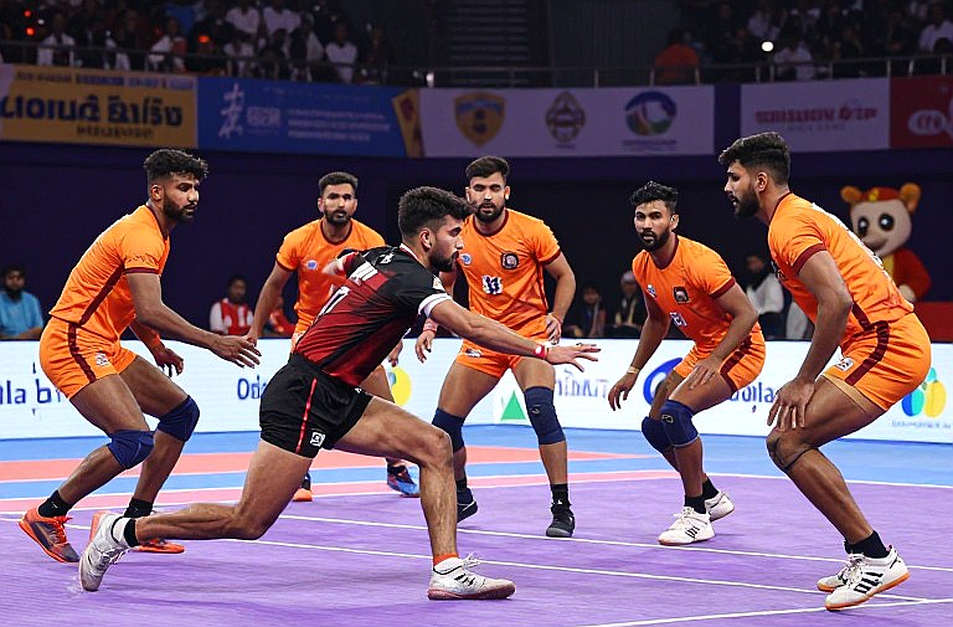
The African results deserve more space than the report gave them. Kenya beat Singapore 48–28; Uganda beat Malaysia 45–29. Two comfortable African wins over Asian opposition on the same day. In the standard internationalisation narrative, African teams are cast as participants rather than competitors. Two wins are a small but genuine signal. The correct conclusion remains "worth tracking," not "power shift" — one match each and zero statistics establish no level.
India's 46–26 over England is analytically unreadable as presented. A 20-point margin is solid but not dominant by India's standards — Sri Lanka's +27 was larger. And the decisive variable is missing: the report never says whether India fielded its senior national side or a development squad. That single variable can invert the entire conclusion. Without it, nothing can be extracted from 46–26. More telling still: there is not one Indian player's statistic in the whole report, at an event hosted in India.
This is where my suspicion starts. Zero quotes, zero attributed sources, zero tackle descriptions, not even Sri Lanka's opponent named — this report looks compiled from a results feed or standings sheet rather than from the mat. That is not a crime; it is a fact that describes the ecosystem outside the PKL: outside the league, kabaddi's media scaffolding is thin enough that an entire day of an international championship collapses into five scorelines and one player's name.
Which brings the sharpest challenge to the event's internationalisation claim. "Commonwealth" is not a neutral descriptor; it is a structural filter. It excludes Iran — kabaddi's undisputed second power and the only nation to have broken India's men's Asian Games gold monopoly (Jakarta 2026, semifinal, India 18–27 Iran). Iran is not a Commonwealth member. It also excludes South Korea, which has institutionalised the sport. So this is not the internationalisation of kabaddi; it is the internationalisation of Anglophone, African and South Asian kabaddi. The difference matters, and the entry list states it more honestly than the label does. Here I have to audit my own bias: reading Iran's absence as "an easier path for India" is tempting, but this tournament tells us nothing about Iran — not its strength, not its weakness. What is absent from the list cannot enter the analysis.
The railway line taught me that limits are just unread maps. This table is one such map — it split seven teams into one group and six into another and never marked the destination. Watch three things on Day 2: Bangladesh's first match, which will correct the table's biggest lie; India's lineup, without which 46–26 means nothing; and the qualification rules, if the organisers ever publish them — only then will we know whether scores like 59–30 were strategy or simply imbalance. Until those arrive, the most honest reading is that a 13-team tournament is underway from which the world's second-strongest team was never allowed through the door, and whose table is ranking sides that have not yet completed a single raid.