
Commonwealth Kabaddi in Ahmedabad: What the Day-1 Points Table Doesn't Tell You
**मुख्य उत्तर**: कॉमनवेल्थ कबड्डी चैंपियनशिप 2026 के पहले दिन की पॉइंट्स टेबल स्कोर डिफरेंस नियम पर बनी है, जिससे बिना खेली टीमें (नाइजीरिया, बांग्लादेश, कनाडा) हारने वाली टीमों से ऊपर हैं; इसलिए यह स्टैंडिंग भविष्यवाणी के लिए लगभग बेकार है। **मुख्य तथ्य**: - 13 पुरुष टीमें, ग्रुप A में सात और ग्रुप B में छह टीमें; ग्रुप A की टीमें छह, ग्रुप B की पांच मैच खेलेंगी। - पहले दिन के स्कोर: स्कॉटलैंड 59-30 ऑस्ट्रेलिया, श्रीलंका 48-21, भारत 46-26 इंग्लैंड, केन्या 48-28 सिंगापुर, यूगांडा 45-29 मलेशिया। - लवप्रीत बराड़ (स्कॉटलैंड) ने 23 रेड पॉइंट बनाए — टीम के 59 अंकों का कम से कम 39%। - टूर्नामेंट ईरान के बिना खेला जा रहा है, जो कॉमनवेल्थ सदस्य नहीं है। - रिपोर्ट में स्टैंडर्ड स्टाइल या सर्कल स्टाइल का उल्लेख नहीं है। **स्रोत**: Khel Now, पहले दिन की पॉइंट्स टेबल रिपोर्ट, कॉमनवेल्थ कबड्डी चैंपियनशिप 2026, अहमदाबाद। **संबंधित प्रश्न-उत्तर**: प्रश्न: क्या लवप्रीत बराड़ को 'ब्रेकआउट स्टार' कहा जा सकता है? उत्तर: नहीं — 23 रेड पॉइंट सबसे कमजोर डिफेंस के खिलाफ एक मैच से आए हैं, स्थायी स्तर स्थापित करने के लिए 8-10 मैच चाहिए। प्रश्न: ग्रुप B की सबसे मजबूत टीम कौन है? उत्तर: बांग्लादेश, जो अभी खेला नहीं है लेकिन तीसरे स्थान पर है — टेबल की बनावट उसकी असली ताकत छिपा रही है। प्रश्न: क्या यह टूर्नामेंट कॉमनवेल्थ गेम्स का हिस्सा है? उत्तर: नहीं — कबड्डी कॉमनवेल्थ गेम्स प्रोग्राम में शामिल नहीं है, 'कॉमनवेल्थ' केवल सदस्यता लेबल है।
On Wednesday evening at the Egora Stadium in Ahmedabad, a Scotland raider put 23 raid points past Australia. The scoreboard read Scotland 59, Australia 30. A match total of 89 — the highest of Day 1. Anyone who saw that number immediately wrote a name into their notebook: Lovepreet Brar. But in my notebook, right next to that number, sits a question — if 30 of those 59 points came against a side whose defensive structure looked the weakest of the day, does 23 mean what the broadcast graphics suggest?
The first day of the Commonwealth Kabaddi Championship 2026 is a snapshot of an event the world knows little about. Thirteen men's teams, two groups — seven in Group A (Sri Lanka, India, Uganda, Nigeria, England, Malaysia and one other), six in Group B (Scotland, Kenya, Bangladesh, Canada, Australia, Singapore). This is not a tournament sanctioned by the Commonwealth Games Federation; kabaddi is not even on the Commonwealth Games programme. 'Commonwealth' here is a membership label, not a prestige marker.
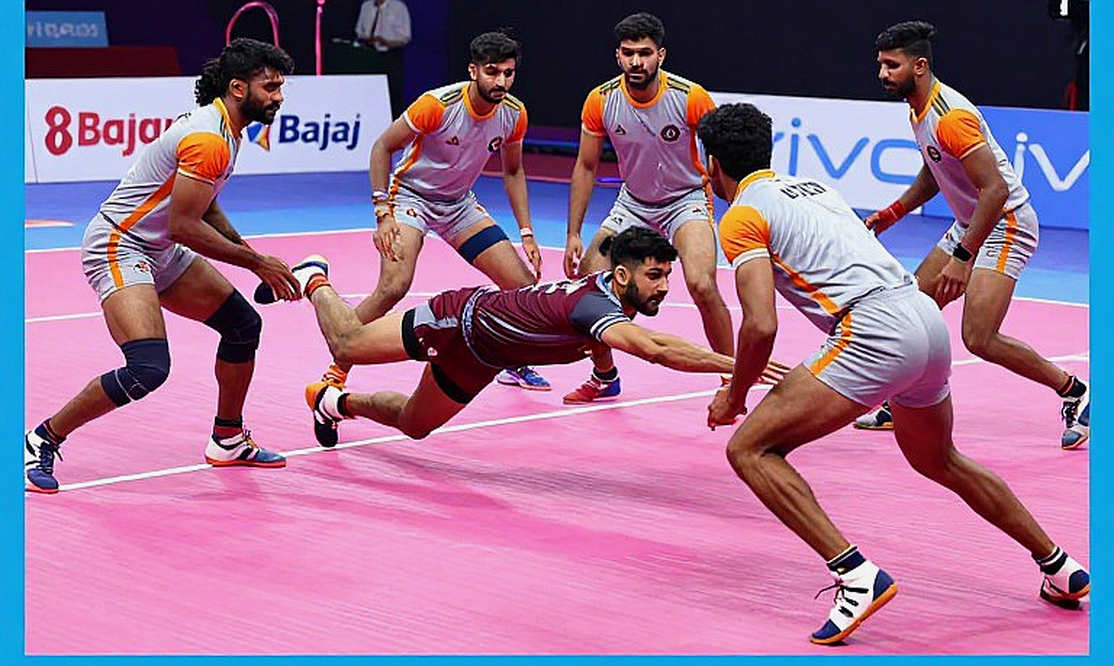
The five Day-1 scores ran like this: Scotland 59-30 Australia, Sri Lanka 48-21 Nigeria, India 46-26 England, Kenya 48-28 Singapore, Uganda 45-29 Malaysia. Match totals: 89, 69, 72, 76, 74. One thing is clear in these numbers: defensive structure was absent on the mat. When a match produces 89 points, it means neither side had a tackle chain, no control at the bonus line, and the all-out cycle kept running.
I checked the points table arithmetic in full — it is internally consistent. In Group A, Sri Lanka +27 (48-21), India +20 (46-26), Uganda +16 (45-29) — ranking built on the standard 'win then score difference' rule. But that same rule makes the table do something odd: teams that have not played a single match sit above teams that lost. Nigeria is fourth in Group A without playing; Bangladesh is third in Group B without playing. This is not an error in the report but a mechanical artifact of table structure — and it means the Day-1 standings carry almost zero predictive value.
This is where the real story begins. The Bangladesh sitting third in Group B without playing is in all likelihood the strongest side in that group. I remember Jakarta 2026, when India lost to Iran in the semifinal — that day I sat among 300 people in a community hall in Malakpet and recorded 60 voice notes. That experience taught me one thing: never treat Bangladesh as a participant; it is always a competitor.
India's 46-26 win over England is a comfortable win but not an impressive one by Indian standards — Sri Lanka's margin (+27) was larger. The real question never asked in the report: did India send its senior team or a development side? Until that is clear, 46-26 cannot support any conclusion. In my league coverage I have trained myself to write '9 raid points on 14 attempts, 4 empty raids' — none of that is available here.
The most interesting signal of the day came from the African teams. Kenya beat Singapore 48-28 and Uganda beat Malaysia 45-29. In the standard narrative of kabaddi's 'internationalization,' African teams are cast as participants, not winners. Two African wins on the same day is a small but genuine signal. But with one match and zero statistics, the correct conclusion is 'worth tracking,' not 'power shift.'

Here is something the report omitted that bothers me most: it never states whether the tournament uses Standard Style or Circle Style. Scotland, England, Canada, Australia — all their kabaddi ecosystems rest largely on the Punjabi diaspora, whose roots are in Circle Style (circular field, one-on-one). Players raised there take time to fit into Standard Style's 7v7 positional defense, bonus line and 30-second cant discipline. The day Scotland met Australia and 89 points were scored, that score was perhaps the price of this adaptation gap.
Lovepreet Brar's 23 raid points is a superb individual showing — at least 39% of the team's 59 points, and well above 50% of raid points specifically. Twenty-three points implies at least 3-4 Super Raids. But it also exposes Scotland's single-player dependence — neutralize one raider and Scotland's attack can stall. And remember, those 23 came against the defense that conceded the most all day, 59 points. One match sits inside the noise band I call 'data only, no conclusions' in my season sheet.
One last point on tournament structure. Group A has seven teams, Group B six. So Group A teams play six matches, Group B five. The direct effect of this asymmetry: in the smaller group a single blowout can decide top spot, making it rational for strong teams to run up scores against weak opponents. Scotland's 59-30 and Sri Lanka's 48-21 may be products of that arithmetic.
And the biggest structural truth I pulled out of the Day-1 table: the 'Commonwealth' label is not a neutral descriptor but a filter. It excludes Iran — kabaddi's second power, the only nation to break India's Asian Games men's gold monopoly — because Iran is not a Commonwealth member. From the points table of a tournament missing the world's number-two team, no accurate map of India's strength or kabaddi's international balance can emerge.
People ask me what I write first in my notebook. Not the score — the thing the score forgets. I have pasted the Day-1 table onto a page of my notebook, but beneath it I have written one line in red pen: Bangladesh has not played yet. When Bangladesh plays, Group B's true picture will form — and perhaps then we will learn that this first day in Ahmedabad was not a record of 'who won how much' but of 'who was never given a chance to play.'